

What Is the Plinko Game and How Does It Work?
Plinko game explained: how the ball picks its slot, what rows and risk levels change, the true edge-slot odds, and where Plinko runs on BitSpinWin.
By Stacy Carmen
2026-10-20
Stacy Carmen
2026-09-30
Content table
Hold and win slots are games with a bonus round where coin symbols stay in place, and you get a few respins to land more coins. So what is hold and win in practice? Every new coin resets your respins, and the round ends when the respins run out, or every position on the grid is filled.
BitSpinWin is a social online casino, and this guide explains how the hold and win feature works. It takes you through a full round, from the start to the final count. By the end, you'll know what the locked coins mean on your screen.

Hold and win slots start their bonus round when a set number of coin symbols land in a single spin. Six coins is a common trigger, but the number changes from game to game. The paytable of each game states the exact figure.
Coin symbols can land in the base game without starting anything. In most games, fewer coins than the trigger number pay nothing on their own and simply clear on the next spin.
When you land enough coins to start the round, the base game pauses. The coins that triggered the bonus stay in place, and all other symbols disappear from the grid.
Next, you'll see a board with some coins locked in place and many empty spots. New coins can land in these empty spaces during the respins. Each coin shows a value, and that value usually scales with the stake you were playing when the round began.
Most games use the same grid as the base game, usually five reels and three rows, for a total of fifteen positions. Some games have a larger grid or add extra rows during the bonus round.
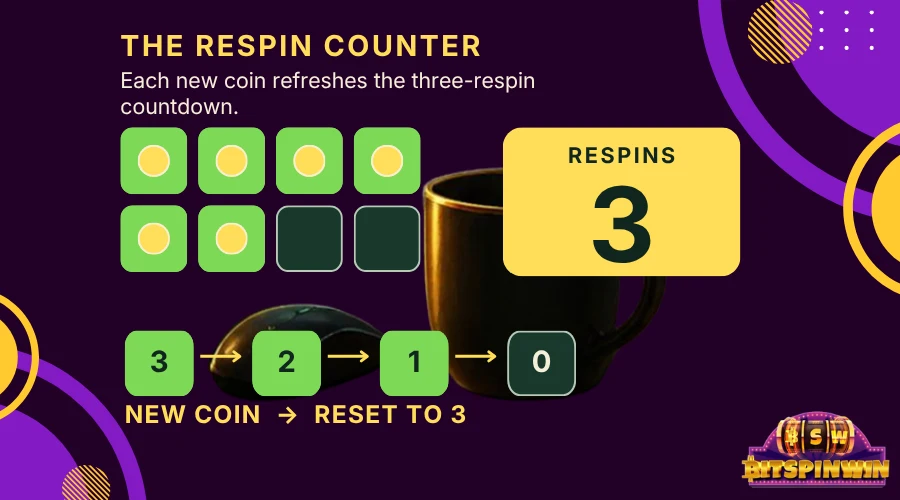
The respin counter decides how long the round lasts, and in most games, it starts at three. Hold and spin slots use a similar system with a different name, but the respin bonus works the same way in both.
You’ll usually see the counter above or next to the grid, shown as a number or a row of lights. You can watch it update after each respin.
Here is how the counter behaves:
This reset rule explains why some rounds are short, and others last much longer. If you get a few coins early, the round can keep resetting and go on for ten or more respins. If the first three respins land nothing, the round ends quickly.
The number of empty spaces matters too. At the start, there are many open spots, so new coins have more places to land. Later in a long round, only a few spaces are left, so each respin has fewer chances to add a coin.
The table below follows one round from the trigger to the end. The values are a made-up example, and they show only how the counter moves.
|
Respin |
New coins |
Coins locked |
Counter |
| Trigger | 6 | 6 | 3 |
| 1 | 0 | 6 | 2 |
| 2 | 1 | 7 | 3 |
| 3 | 0 | 7 | 2 |
| 4 | 2 | 9 | 3 |
| 5 | 0 | 9 | 2 |
| 6 | 0 | 9 | 1 |
| 7 | 0 | 9 | 0 |
In this example, the round lasts for seven respins. The counter resets after respin 2 and respin 4, then counts down with three empty respins in a row. When the counter reaches zero, the game adds up the values on the nine locked coins. That total is your payout for the round, plus any jackpot from a special coin. For example, if the nine coins showed 1x, 1x, 2x, 2x, 2x, 3x, 5x, 5x, and 10x your stake, the round would pay 31 times your stake. These numbers are just examples; real coin values depend on the game and your stake.

Most hold and win slots attach four named prizes to the round: Mini, Minor, Major and Grand. In many games, special jackpot coins carry the first three. The Grand is often awarded for filling every position on the grid.
In games that award the Grand for a full grid, every remaining space has to be filled before the counter runs out. That is why the Grand sits at the top of the list.
The four prizes are not all built the same way. In some games, each named prize is a fixed multiple of your stake, and the paytable lists the exact figure. In others, one or more of them is progressive.
A progressive prize increases over time and resets to its starting value after someone wins it.
If you want to know how jackpot size relates to the rest of a game's math, the guide on what RTP means explains the payout figure listed in most paytables.
Games with a growing Grand work differently from fixed-prize games. The guide to progressive jackpot slots covers how those growing prizes build up and reset.
Before you play, check two things in the paytable:
Some hold and win slots add special coins that change what happens during the respins. Not every game has them, and each game uses its own mix.
The most common types are:
The paytable shows which special coins a game uses, but it doesn’t say how often they appear. Think of them as extra rules for the round, and read what each one does before you play.
Hold and Win and free spins are both bonus rounds, but they work in different ways. Free spins replay the normal reels, while hold and win plays out on a locked grid of coins.
|
|
Hold and win |
Free spins |
| What triggers it | A set number of coin symbols in one spin | Usually a set number of scatter symbols |
| What you watch | The respin counter and the empty positions | Normal wins on the paylines |
| How it ends | The counter reaches zero, or the grid fills | The set number of free spins runs out |
| Where the value sits | Coin values and the named jackpots | Line wins, often with a multiplier |
Some games offer both features, and sometimes one can lead into the other. Players often mix these up with cascading reels, where winning symbols disappear, and new ones fall into place during a regular spin.
The paytable answers most questions about hold and win slots before you spend any money. You can open it from the menu or by clicking the information button in the game.
Check these five points:
A higher stake usually means higher coin values, but it also means each spin costs more. Choose a stake you’re comfortable losing, and use the paytable to see what the round can pay.
For a wider look at how different slot types compare, the slot games review covers classic, video, and progressive games side by side.
New players can try a game on BitSpinWin with sign-up free play once their account is verified. That lets you watch a hold and win round in action before adding your own funds.
Hold and win is a bonus feature that locks coin symbols in place and gives you a few respins to land more of them. Each new coin resets the respins count, usually to three. The round ends when the respins run out or the grid fills up.
The number of coins that trigger hold and win depends on the game. Six coins in a single spin is a common trigger, and some games need more or fewer. Each game's paytable states the exact number, usually on the page that explains the bonus round.
Hold and win is a different feature from free spins. Free spins replay the normal reels with the usual paylines. Hold and win plays out on a grid of locked coins, and the round ends when the respin counter reaches zero or every position is filled.
Slot play at BitSpinWin is for entertainment, and every session carries a risk of losing what you put in. Set a budget and a time limit before you play, and stop when you reach either one. If it stops feeling fun, you can get help at 1-800-GAMBLER.
This content is not legal advice.
Plinko game explained: how the ball picks its slot, what rows and risk levels change, the true edge-slot odds, and where Plinko runs on BitSpinWin.
By Stacy Carmen
2026-10-20

What is a casino house edge? See the simple math behind it with one worked example, how it links to RTP, and why it only shows over time. Read the math.
By Stacy Carmen
2026-10-14

Are online slots rigged? What an RNG certificate proves, what it does not, why losing streaks feel fixed, and how to check a game before you play.
By Jarret Smith
2026-10-06