

What Is the Plinko Game and How Does It Work?
Plinko game explained: how the ball picks its slot, what rows and risk levels change, the true edge-slot odds, and where Plinko runs on BitSpinWin.
By Stacy Carmen
2026-10-20
Jarret Smith
2026-10-01
Content table
What does volatility mean in slots? It's the difference between a game that pays you small amounts often and one that makes you wait for something bigger. Two slots can share the same long-term payout rate and still feel completely different to play, and volatility is why.
You'll see it labeled on the game card at BitSpinWin, a social gaming platform with online slots from many providers. This guide breaks down what each volatility level actually means. A worked example walks a single starting balance through two very different sessions. A short list at the end helps you match a level to your budget.
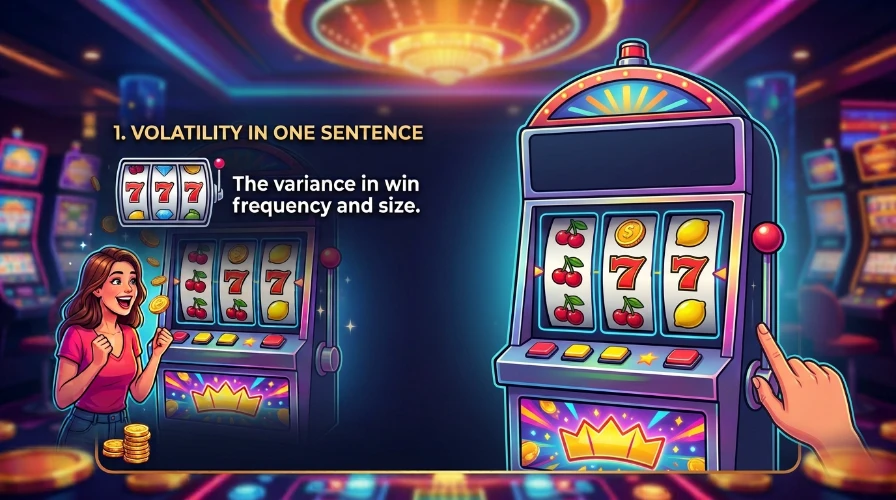
With slot volatility explained in one line, it is the pattern of wins a game produces: Low volatility means frequent small wins, while high volatility means rare big wins. Volatility does not affect the total payout over time, only how it is distributed during your session.
Players and game providers also call it variance. Both words mean the same thing, and game info screens use either one. Game designers set volatility by deciding how prizes are spread out. If most of the value is in a few big prizes, wins happen less often. If the value is spread across many small prizes, wins come more often but are smaller.
The clearest way to compare high volatility vs low volatility slots is to look at the same five questions for each level. The table uses simple descriptions instead of percentages, since numbers can vary between games.
|
|
Low volatility slots |
Medium volatility slots |
High volatility slots |
| How often wins land | Often | Fairly often | Rarely |
| Typical win size | Small, often close to the stake | Mixed, small wins with some larger ones | Large when they land, with many empty spins between |
| How fast a balance swings | Slowly, in small steps | Moderately | Sharply, in both directions |
| How bonus rounds behave | Trigger more often, pay modest amounts | A balance of frequency and size | Trigger rarely, carry most of the game's top prizes |
| Who it suits | Long sessions on a small balance | Players who want some of both | Players who accept long dry spells |
Each row shows a general trend, but any single session can be different. Even a low volatility game can have a long losing streak, and a high volatility game might pay out early. Over many spins, though, the table’s pattern usually holds true. The middle level is more important than it seems. Many slots have medium volatility, and games labeled medium-high or low-medium fall between two levels. Some info screens call this level balanced or average instead of medium.
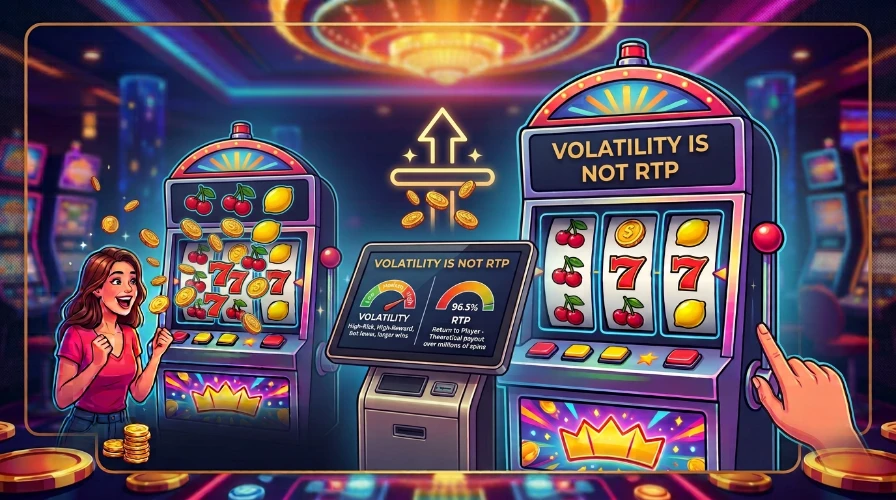
RTP is the percentage of all bets a game pays back to players over time. Volatility is about how unevenly those payouts happen. For more details on RTP, see the guide on what RTP means in slots.
The simplest way to understand volatility is to play two games with the same starting balance. The numbers below are just examples and do not predict real results. Actual sessions can turn out very differently. For example, start with 100 coins and play 100 spins at 1 coin per spin. Game A has low volatility, and Game B has high volatility. Both games have the same RTP.
|
Checkpoint |
Game A balance (low) |
Game B balance (high) |
| Start | 100 | 100 |
| After 25 spins | 96 | 78 |
| After 50 spins | 99 | 61 |
| After 75 spins | 93 | 104 |
| After 100 spins | 91 | 86 |
Game A changes slowly. Wins come every few spins, most are close to your bet amount, and your balance stays near where it began.
Game B is different. In the first 50 spins, your balance drops by almost 40 coins, with only small wins. After spin 50, a bonus round boosts your balance above where you started, but by the end, it drops again.
The table also hides one detail. In this example, Game A's best single win is about 8 coins, while Game B's bonus round pays 55 coins in one go. That one round is where most of Game B's return for the session sits.
Both sessions finish with less than 100 coins, which is normal for slots in the short term. Volatility only changes how you get there.
Game A never threatened the balance, while Game B needed a bonus round to recover. A player with only 40 coins would have run out on Game B before the bonus arrived.
This is the key takeaway: in high volatility games, your balance size decides if you can keep playing long enough to hit the bigger wins.
Your bet size matters too. If you bet half a coin per spin, your 100 coins last for 200 spins on Game B. This gives you more chances to reach a bonus round, and each losing spin costs less.

Most slots display their volatility, but if they do not, you can look for four clues:
No single clue is perfect, but using two or three together usually gives you a good idea. Volatility labels are not always the same. Each provider uses its own scale, so a game marked high by one company might feel more like medium at another. Use the label as a guide and check the other clues too.
Much of the confusion about what does volatility mean in slots comes from three myths:
If you want to compare different game types and their features, the slot games review lists volatility alongside RTP for each one.
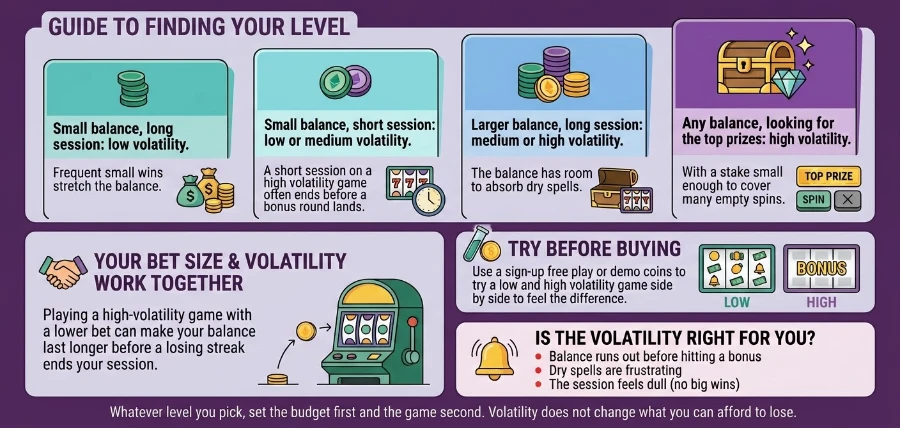
Knowing what does volatility mean in slots matters most when you choose a game for your own budget. The best level is the one your balance can handle for as long as you want to play. Here’s a quick guide:
Your bet size and volatility work together. If you play a high-volatility game with a lower bet, your balance lasts longer before a losing streak ends your session. Many players with small balances start with low-stake slots.
You can also feel the difference before buying coins. New players can use BitSpinWin sign-up free play once their account is verified, and try a low and a high volatility game side by side.
There are signs a game’s volatility is not right for you. If your balance runs out before you hit a bonus, dry spells are too frustrating, or the session feels dull because nothing big happens, it might be time to try a different level.
Whatever level you pick, set the budget first and the game second. Volatility tells you how a balance is likely to move. It does not change what you can afford to lose.
The best volatility for slots depends on your budget and your patience, and no single level suits everyone. Low volatility is good for longer sessions with a small balance. High volatility is for players who can handle long dry spells and want a shot at bigger wins, as long as their balance can last.
High volatility makes bigger wins possible, but it also makes them rarer. Most spins pay less than your bet or nothing. Big wins usually come in bonus rounds, and many sessions end before you get one.
Volatility and RTP are two different measures. RTP is the long-run average share of stakes a game returns. Volatility describes how unevenly that return arrives, from frequent small wins at the low end to rare large ones at the high end.
A slot's volatility is usually listed on the provider's info screen or in the paytable, as a word or a scale. If it is missing, check the top prize as a multiple of the stake and how often the bonus round triggers. Both point to the level.
Volatility does not change while you play. It is built into the game and stays the same for every spin. Things like the time of day, recent wins or losses, or how long you have played do not affect it.
Playing slots at BitSpinWin is meant to be fun, but you can lose the money you put in. Set a budget and a time limit before you start, and stop when you reach either one. If playing stops being fun, you can get help at 1-800-GAMBLER.
This content is not legal advice.
Plinko game explained: how the ball picks its slot, what rows and risk levels change, the true edge-slot odds, and where Plinko runs on BitSpinWin.
By Stacy Carmen
2026-10-20

What is a casino house edge? See the simple math behind it with one worked example, how it links to RTP, and why it only shows over time. Read the math.
By Stacy Carmen
2026-10-14

Are online slots rigged? What an RNG certificate proves, what it does not, why losing streaks feel fixed, and how to check a game before you play.
By Jarret Smith
2026-10-06